
The VerifAIX AI Verification Platform
A spec-first, agentic AI platform that takes verification from spec audit through closure, preserving traceability at every step.
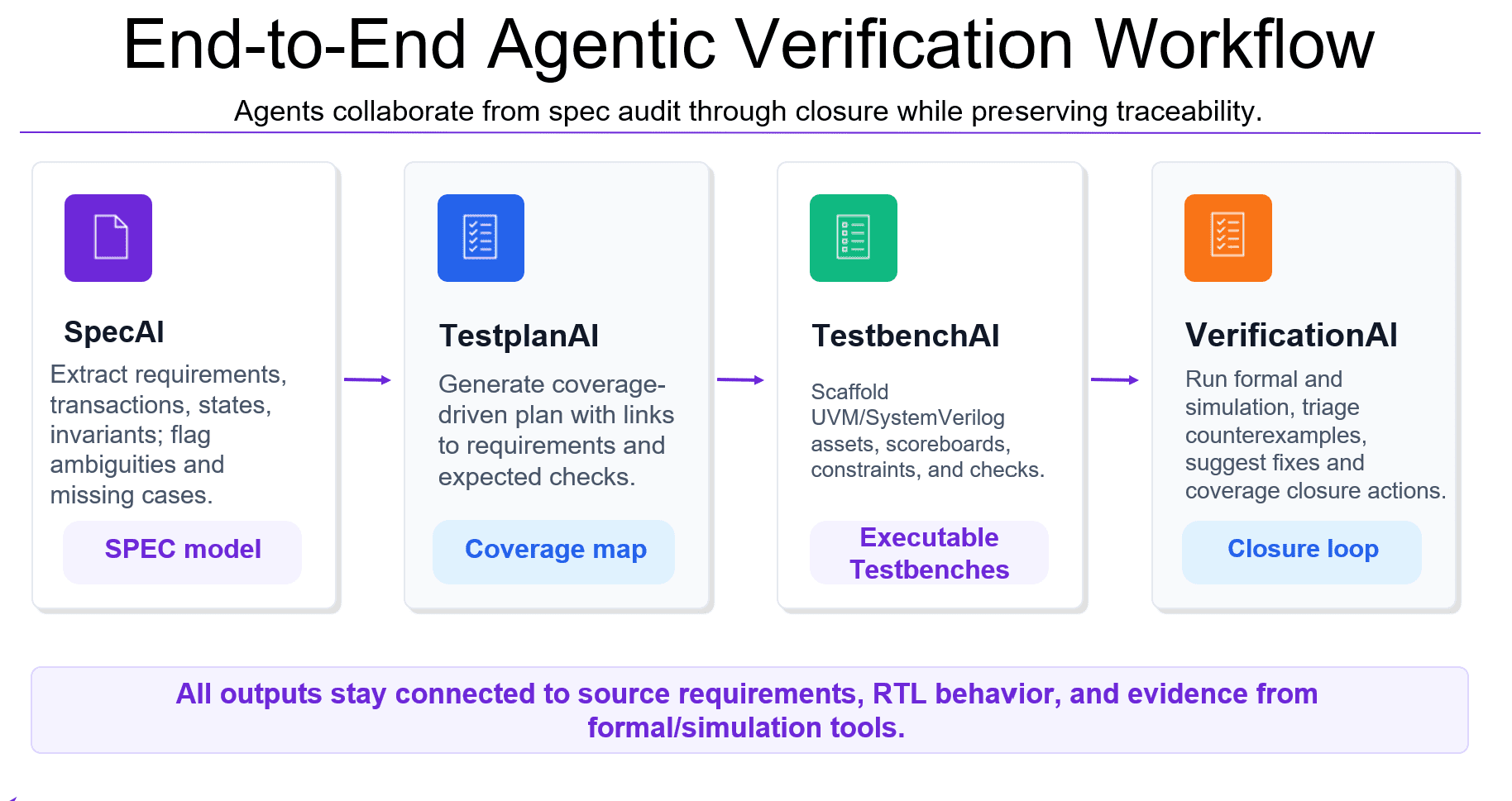
VerifAIX is an agentic AI platform for hardware verification, built on the principle that verification starts with a complete and consistent view of your design and its specifications. It audits your architecture and micro-architecture specifications against your RTL, distilling them into a formally grounded model of your design we call the Formal Brain. Your team reviews and approves this model interactively before it drives any downstream work. From there, specialized AI agents generate and validate test plans, testbenches, assertions, and coverage workflows, driving your existing EDA tools through to closure.
VerifAIX differs from other AI verification solutions because every agent works from the same Formal Brain. Every test case traces to a spec requirement, every testbench traces to the RTL signal it covers, and every failure points directly to where and why. The result, using tools your team already knows and trusts, is a verification process that is both faster and provably complete.
SpecAI Agent
Specification Audit of Architecture and Micro-Architecture Specs Against RTL
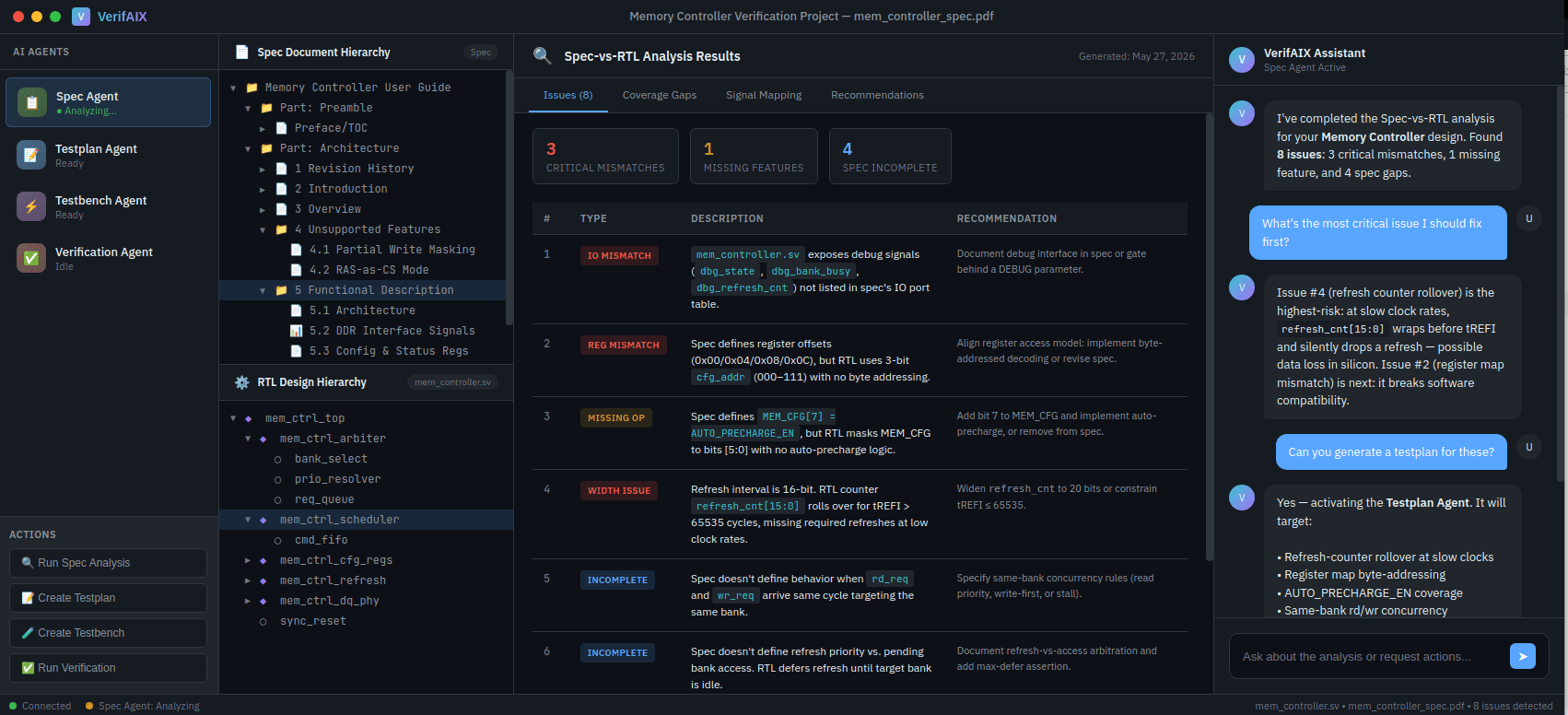
Verification problems almost always start in the specification: ambiguous language, missing edge cases, undocumented behavior. SpecAI finds these flaws up front, before any verification work begins, and gives your team a reviewed and approved Formal Brain model of the design as the foundation for everything that follows. Your engineers decide what to accept, correct, or investigate, so no downstream agent ever works from an assumption your team hasn’t seen.
Key Features:
- Extracts transactions, states, and invariants from specification text
- Reads RTL alongside the spec to catch signals, behaviors, and edge cases the specification missed
- Distinguishes spec omissions from genuine design discrepancies
- Flags contradictions, ambiguities, and missing cases in the spec
- Maps requirements to verification checks and coverage targets
- Maintains full traceability to source spec sections throughout
The outcome is confidence that your verification starts from a complete and consistent picture of your design and specifications.
TestplanAI Agent
Testplan and Coverage Model Generation
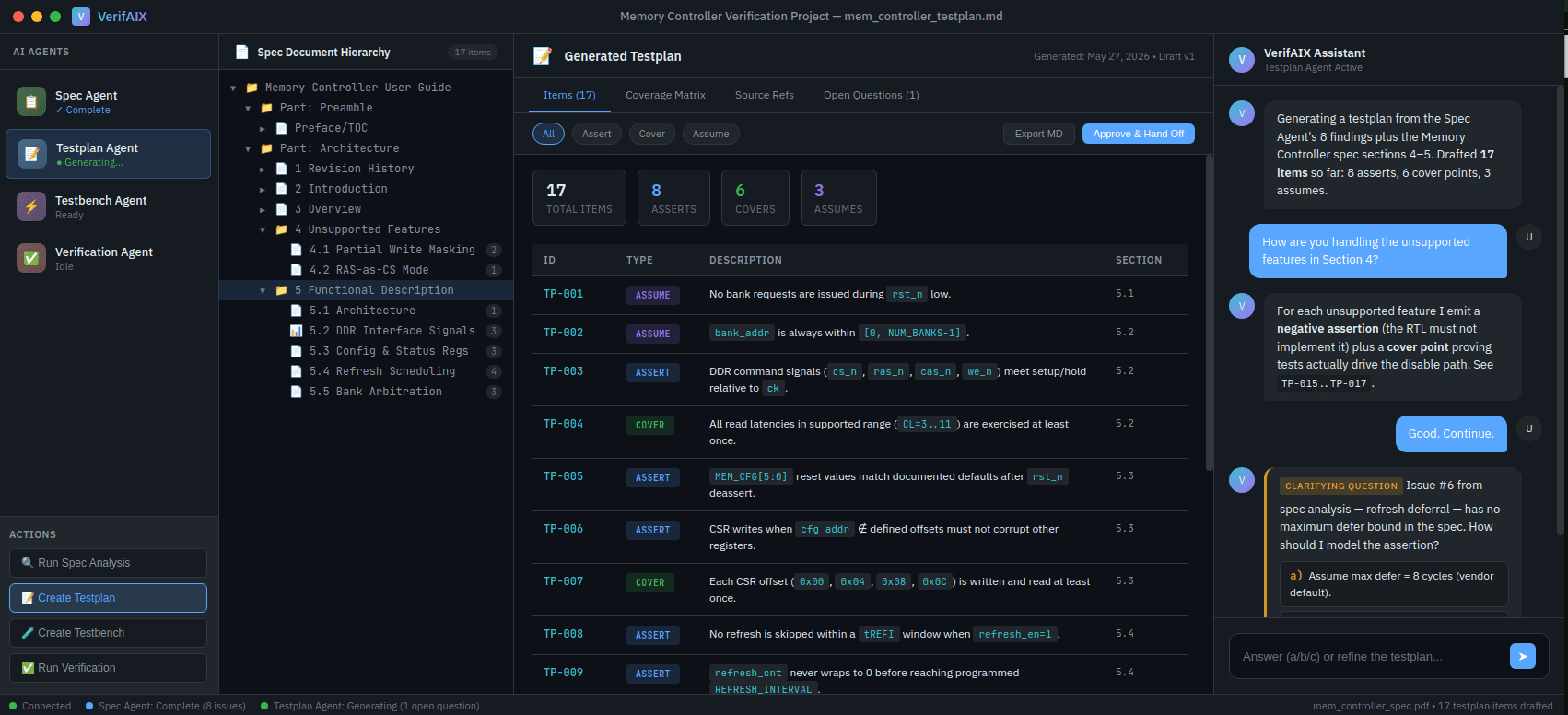
Writing a verification plan from an imperfect spec means guessing at intent, and guesses become coverage holes. TestplanAI removes that guesswork by working directly from the Formal Brain model your team has already reviewed and approved. The plan it produces is one your engineers can trust and defend in review: complete, measurable, and generated in hours rather than weeks.
Key Features:
- Generates a complete coverage-driven verification plan from the Formal Brain model
- Links every test case to its source requirement for full traceability
- Produces a coverage map that makes completeness measurable and provable
- Flags requirements without corresponding test coverage
- Outputs a plan that feeds directly into testbench generation
The outcome is a verification plan you can hand to your team on day one, with traceability built in.
TestbenchAI Agent
Testbench and Code Generation
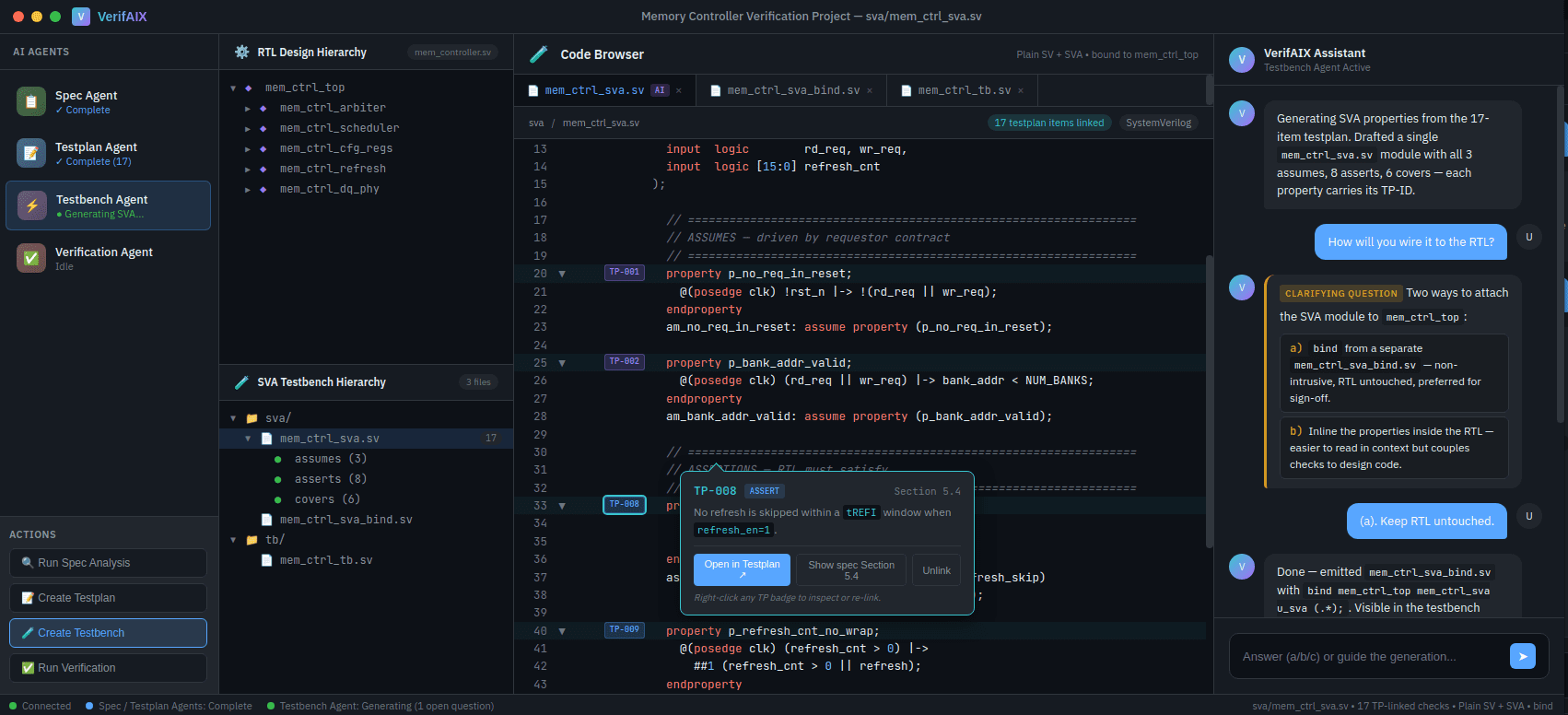
Building a testbench from scratch can take months of manual effort, and much of that time goes to plumbing rather than verification insight. TestbenchAI generates that collateral directly from the verification plan and the Formal Brain model, so everything it produces reflects design behavior your team has already approved. When a test fails, your engineers spend their time on the bug, not on reconstructing what the test was checking or why it exists.
Key Features:
- Generates executable UVM/SystemVerilog testbench scaffolding
- Produces assertions and constraints derived from the Formal Brain your team approved
- Creates scoreboards and checker logic automatically
- Maintains RTL-level traceability so failures point directly to the source
- Provides formal and simulation debug assistance throughout
- Delivers coverage closure guidance to eliminate blind spots
The outcome is executable verification collateral that is grounded, traceable, and ready to run.
VerificationAI Agent
Orchestrates Simulation and Formal Engines to Closure
VerificationAI drives your existing formal and simulation tools through to closure, taking on the work that consumes much of your engineers’ time: triaging counterexamples, chasing coverage gaps, and grinding through regressions toward sign-off. Your team stays in control throughout, reviewing findings and recommendations, and nothing touches your spec or RTL without explicit approval.
Key Features:
- Orchestrates formal and simulation runs through your existing EDA tools via standard APIs
- Tool-agnostic, connecting to your existing simulators, model checkers, and formal engines
- Automatically triages counterexamples and identifies root causes
- Highlights coverage gaps and suggests targeted closure actions
- Iterates over repair candidates and regression evidence until closure is achieved
- Human-in-the-loop at every stage, recommendations only, never autonomous RTL changes
The outcome is faster verification closure with complete auditability, from counterexample to sign-off.
What Makes VerifAIX Different
The Formal Brain Model
A formally grounded representation of your design that captures spec intent, RTL behavior, dependencies, and design structure. Every agent works from this shared model.
Spec-First with Traceability
Every generated artifact maps back to requirements, transactions, states, and coverage intent.
AI with Deterministic Validation
LLM outputs are constrained and validated using deterministic analysis and formal checks, so no single engine is generating and checking its own work.
Closure-Oriented Agents
Agents don’t stop at generation; they iterate on coverage gaps, counterexamples, and regressions until closure.
Fits Your Existing Flow
Works with your existing verification assets, simulators, model checkers, and EDA tools via standard APIs.
Ready to See VerifAIX in Action?
Reach out to learn more, schedule a demo, or evaluate VerifAIX on your own design.